"Do you mind if we reschedule the meeting once more?" asks one of our clients, glaring at his phone with annoyance. Another email from China, and the talks are stalled again. A typical case Belarusians are getting used to.
Over the past few years, we at Arzinger Law Offices have added a number of large investment projects to our portfolio, from both Belarus and China. They gave us a better idea of the way Chinese think and manage things. While we don't pretend to be professional sinologists, we can share our observations and experience that, in our view, will certainly help Belarusian business shape their relations with China partners.
China: a mosaic, not a monolith
Chinese business culture is vast and diverse. In Zhejiang, decisions are made with lightning speed, while in Shenzhen, the same request can take weeks. As we worked on a major infrastructure project, it became clear that understanding your partner’s ways helps avoid excessive haste or grueling waits.
There is one common feature, rooted in the tradition of intense competition and resulting adaptability of Chinese partners. Being cunny does not mean poor business ethics or dishonesty. Rather, it shows one’s intelligence. Yours, more exactly. If you let others outsmart you, it only means that you are silly and have lost this small battle over deal terms. There is nothing immoral, unethical, or dishonest about that.
You are only as tough as your interpreter
Our clients do a lot of “homework” prior to the talks, planning arguments, countermoves, and tactical retreats. But the issue of translation is quite often (and understandably) overlooked. After all, few possess firsthand experience of working in two languages, and lacking that, one can hardly imagine all the challenges facing an interpreter at business talks. And without a decent command of Chinese, one cannot fully control the quality of interpretation. Besides, interpretation services are expensive, and one is always tempted to spare on them when the Chinese bring their own interpreter along.
However, if the linguist is not familiar with your industry, inexperienced in talks, and not fluent in the language, then your negotiating power will not exceed that of your interpreter who will have hard time conveying your words and arguments to the other party. This is a key consideration to keep in mind, and if China is your primary focus, we strongly recommend hiring an interpreter of record whose skills andf qualifications you can fully trust. And don't forget to adapt your speech to Chinese syntax: keep phrases short and simple.
One must also stay alert to surprises when your interpreter is not your national. In one case, a Chinese student at a Belarusian university was hired by the Belarusian party to interpret the talks. As soon as the talks were over he asked for a job with the Chinese party and was accepted.
 Stratagem Thinking: The Chinese Code for Success
Ancient Chinese are famous for their military treatises. One of them is the "Thirty-Six Stratagems." A stratagem is a behavioral pattern that wins with intelligence, rather than bloodshed. Each stratagem is illustrated with a story about a battle won in a specific way and is summarized in a short statement:
• "Shanwu chouti" (上屋抽梯) – "to lure someone onto the roof of a house and remove the ladder from above." In business, this means luring you into negotiations and then blocking your retreat, increasing your dependence. As we were working on a project to build a renewable energy power plant, the Chinese offered to cover part of the construction site costs. But at the final stage they suddenly demanded from the Belarusian partner to increase its share of investment.
• "Paozhuan yinyu" (抛砖引玉) – "throwing a brick to attract jade." Here, they first offer you an attractive but small concession as a "bait" to entice you to disclose your bigger concessions.
The Chinese learn to think in stratagems from their childhood, just as the Slavs learn proverbs and sayings. If we say "the ball comes to the player," the Chinese recall 調虎離山 – "Lure the tiger from the mountain to the plain" (never attack an opponent who has an advantage).
Understanding basic stratagems allows you to anticipate your opponent's moves and seize the initiative in advance.
Negotiations – a battlefield
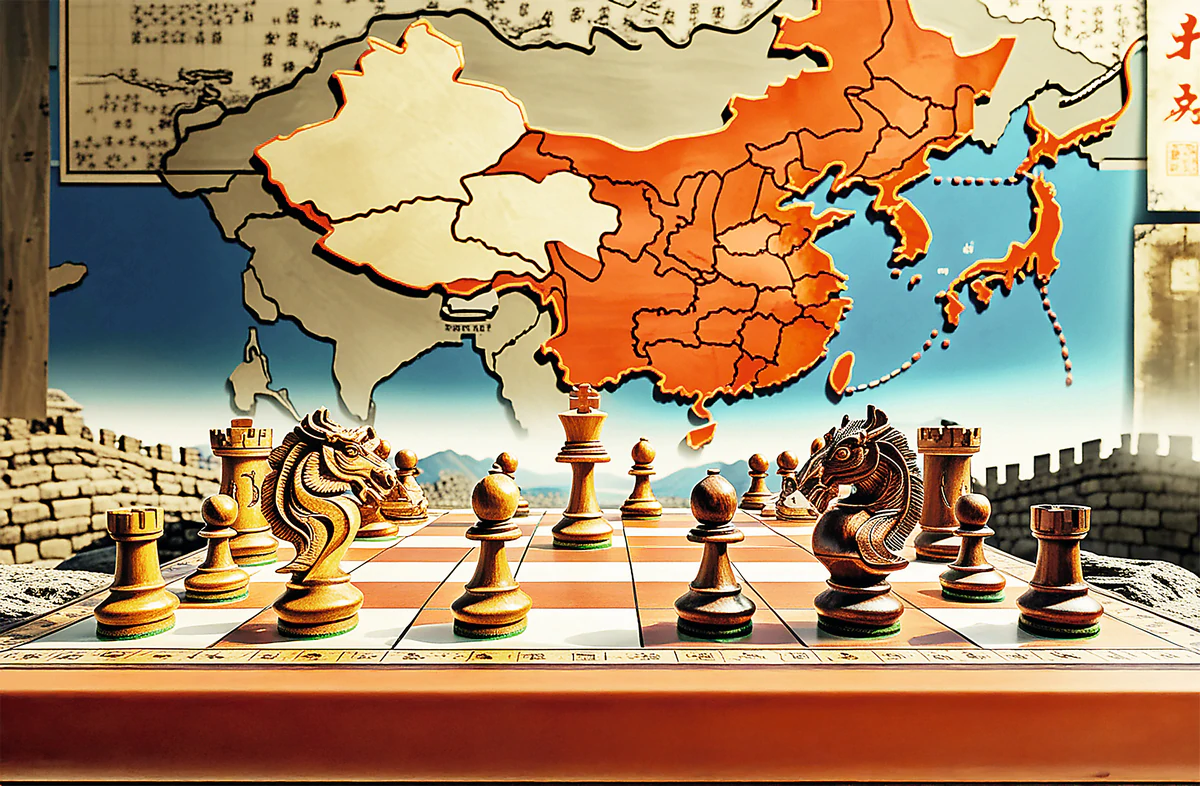
Negotiations are often compared to chess, but in China they are more like a "three-dimensional battlefield." Here are the main techniques:
• Mask true goals. While you're discussing small matters like payment schedules, a new project is being crafted behind the scenes, which is held in secret until the final round.
• Delays. Constant postponements and "technical breaks" test your endurance and financial flexibility.
• "Kill with someone else's knife." Involving third parties (suppliers, subcontractors, government agencies) in the process to build up pressure.
A skillful negotiator prepares several scenarios: tough, moderate, and "backup." We advise to agree beforehand on all deadlines, penalties, and modalities of inviting other stakeholders.
Know Your Partner
Investigating beneficial ownership structures and holding chains in China can take weeks. In one project, we discovered that the ultimate owner was not a state enterprise, but a private investor. As a result, we had to seriously adjust the financing mechanism and radically rethink ways of engaging with regulators.
Recommendations:
1. Conduct an audit three levels deep into the holding chain.
2. Check public registries and sectoral media for high-profile cases.
3. Always consider possible public participation in shareholder structures.
Decoding the Chinese "No"
You'll rarely hear a direct "no." Instead, there are such polite phrases, as:
- I'll think about it.
- We need to coordinate with management.
- Let’s come back to this later.
If you get no concrete feedback within a week, there's a high probability that the matter is effectively closed. After the meeting, send the minutes with deadlines to your partner ASAP and ask him to confirm each point with an "OK".
Practical Recommendations
• Build a "team of four": two representatives from your company, an interpreter (ideally, your national), and a sectoral expert.
• Structure your speech for the interpretation: short sentences and clear terminology.
• Set intermediate milestones and record them in minutes or via messengers (WeChat).
• Ask direct questions about the other party’s authority: "Are you authorized to sign the contract?"
• Add a clause into your contracts to allow for a reviewal after 6-12 months.
Chinese negotiations are a symbiosis of ancient military strategies and modern technologies. The ability to read the unspoken, understand stratagems and cultural codes, and build communication through WeChat and structured protocols creates a real competitive advantage.
If you fully leverage deep international experience, then your projects with China will gain momentum with minimal costs and maximum results.


 Subscribe to news